The Cockfighting Question
Animal Rights and the Christian Conscience

Dear friends,
This article is a little less curious history and a little more – well, look, it’s about cockfighting, the first animal welfare act and the chicken industry today (and a bit of curious history, of course). If you are having a beautiful sunny weekend, this one might put you off your Sunday roast. You might want to put it aside for later.
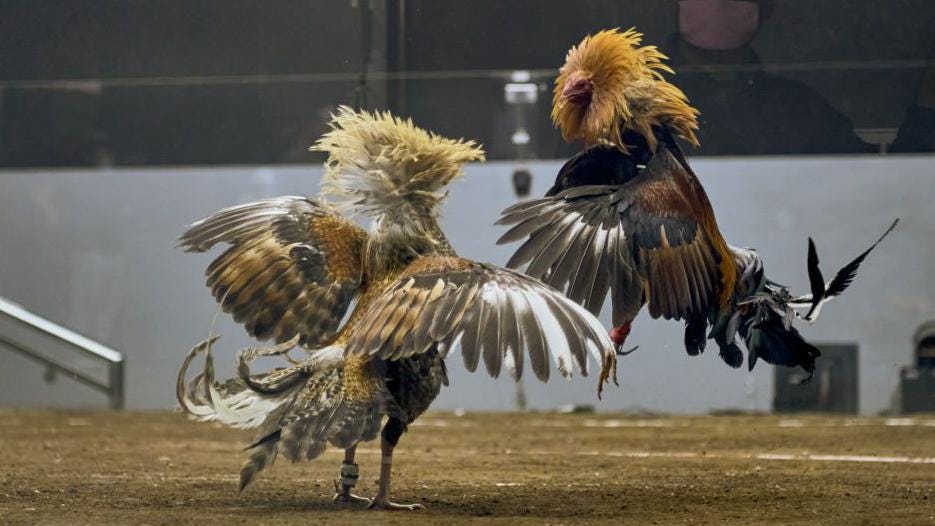
‘You don’t have cockfighting in London Ma’am?’ The driver looks in the rearview mirror at me, visibly shocked. He expresses surprise that cockfighting hasn’t yet reached Britain. He offers an enthusiastic introduction to the ‘sport’ and his own involvement in it.
‘Is there a cockfighting pit in town?’ I ask. Taking my question as interest in attending, I am given a full break down of when fights are on, which are worth watching, and how much is at stake. Winning a fight can carry a cash prize of 70,000 pesos, approximately £885 – a third of most peoples’ annual salary in the Philippines.
‘But,’ the driver finishes, you make the most if you bet.’
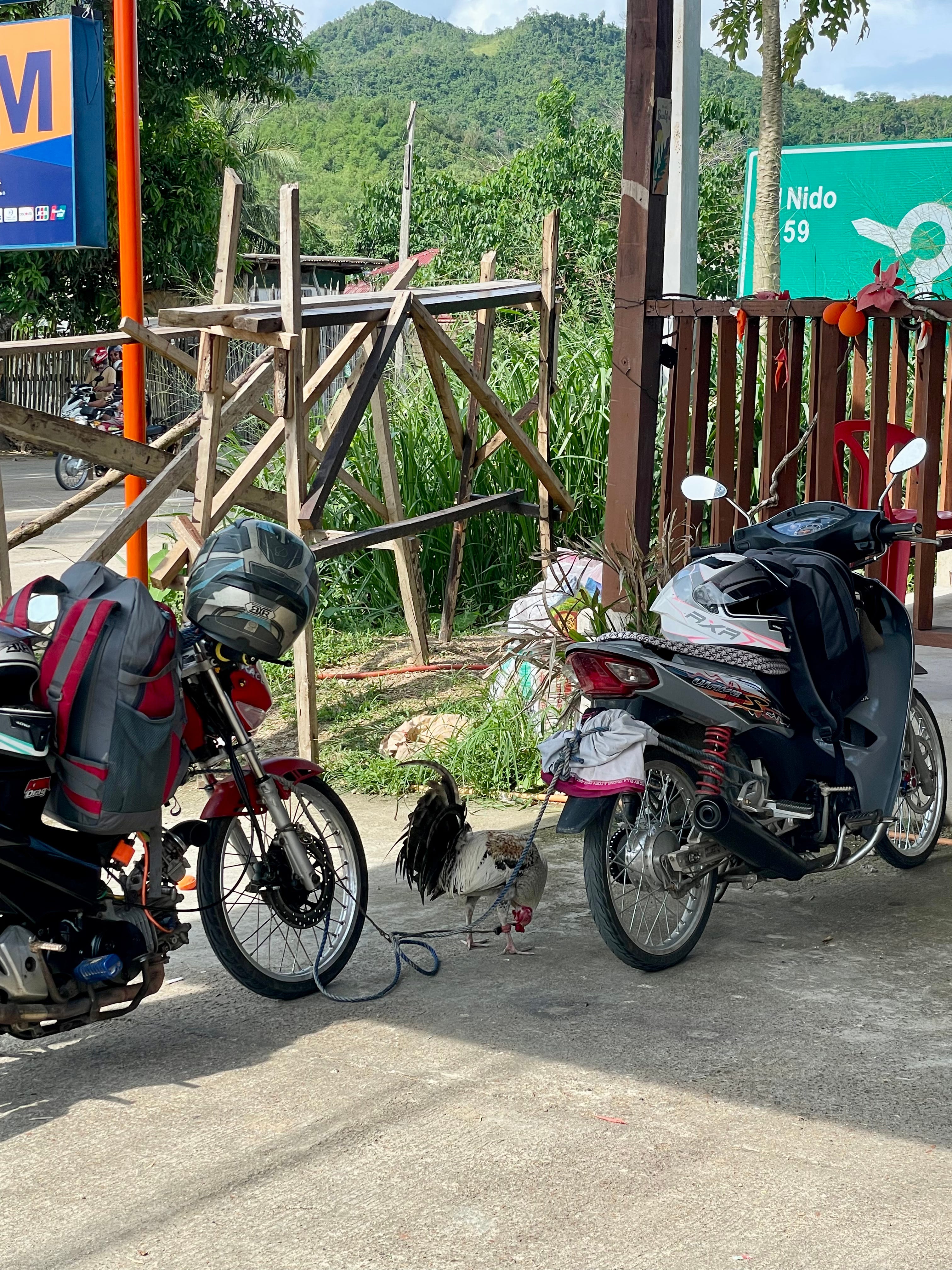
Cockfighting is rife in the Philippines. Beyond Metro Manila, many houses have cockerels tethered outside. Some have rows and rows. Each cockerel typically has a little wooden shelter and a couple of metres of twine attaching him to his stake, so he can wander around in a circle in the sunshine, scrapping around for insect snacks, or rest in the shade beneath his shelter. They are handsome birds and a significant part of island life. On the south of Cebu Island, I am woken each morning at 3am by the clockwork crowing. During the Philippine winter, when daylight begins and ends early, many people start their day at this ungodly hour. I roll over and try to get some sleep before breakfast – eggs and rice.
I see my first cock fight near Moalboal. Of all places, it takes place outside a stray dog shelter. I don’t mean to see it, but I can’t help but walk past. Two men untie a pair of cockerels. Holding them under the belly and around the neck, they rock them back and forwards at each other several times. By the fourth rock, the cockerels almost touching, their neck feathers spring to attention and they become aggressive. The men release the birds into the air. Before they land, the cockerels are at each other, striking with their claws. The same scene plays out repeatedly across the islands, casually, everywhere, even - on one occasion - as we are canyoning down a waterfall in the middle of a rainforest. There is no road for miles around, but a steady trail of tourists make it a good place for a few huts, and with huts come cockerels. Our guide picks up a couple in jest, whose feathered collars rise like the hackles of dogs.
‘Does he think tourists like this?’ My husband Hamza asks. I shrug. Maybe they do.
The Animal Rights Act
I was initially shocked to see ‘chicken fighting’, as it is called in the Philippines. Arena blood sports are antithetical to my understanding of Christianity. But when I gathered my thoughts, I remembered bull fighting is still practiced in Spain (perhaps not surprising when you consider the Holy Roman Empire days and gladiatorial combats). The Philippines is also a Catholic country. It was colonised by the Spanish in 1565, who finally ceded control in 1898 to the Americans.
They say that when He comes, there will be signs. As we hop between islands, there are certainly signs that someone is pushing a hard Christian agenda here. There are signs on every corner and on the sides of most buildings as well, almost all in English. Some printed, some painted: ‘Hope of God: raise up reproducing disciples and shepherds’ ‘and ‘Gods fresh ministries’. It looks like the missionaries got here before God did.


We are told there is a shortage of cash on the island. The ATMs are empty. The dispensers whirl then dry cough to a stop. There isn’t any water at the airport today either. I avoid the toilets.
There might not be fresh water, but there are more churches here than people. A charity worker tells me villagers anywhere are happy to take a church’s money if it funds schools and medical supplies and keeps their children alive. Surely charity stops being charity if it demands something in return? The people nod through the sermons and put up signs in a language they don’t speak at home.
What language does God speak? Why not Tagalog?
Why had I assumed Christian countries didn’t partake in arena blood sports? I think it is because animal rights were written into the Quaker agenda at the very beginning of the movement, alongside other forms of justice. Quakers are a homegrown radical Christian movement, founded in the North of England during the mid seventeenth century. They are the group my understanding of Christianity comes from. But clearly, that understanding of Christianity is not universal.
Cruelty to animals was high on the Quaker agenda back in the 1660s. The year after Oliver Cromwell died, Quaker leader George Fox published a pamphlet outlining his views of what a good government should be, known as the Fifty-Nine Particulars. Key themes became the tenants of Quakerism, unifying the scattered Christian movement. Fox outlined religious freedom, economic and social justice, legal and penal reform and opposition to violence. He also demanded the abolition of violent animal sports such as bullbaiting, alongside other nonviolent but ‘frivolous’ activities.1
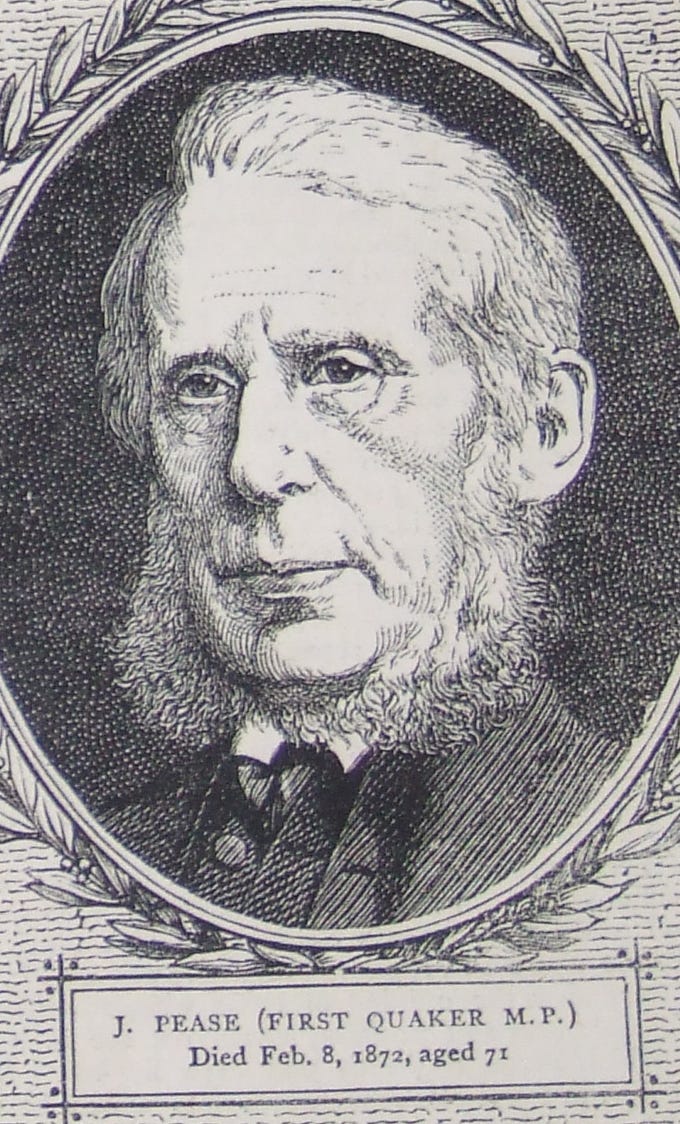
Quakers didn’t have any power to enact legal change in the 1660s. It was almost two hundred years before a Quaker was allowed into Parliament. Finally, in 1832, Joseph Pease became the first Quaker MP in Britain.2 He was not allowed to take up his seat in Parliament for some time, because he refused to take the oath of office. Quakers traditionally did not swear oaths, because they believe everyone should always speak the truth. Eventually, a committee decided that Pease could affirm, rather than swear himself in office. Pease also, like most Quakers of the day, refused to remove his hat, even when he entered the House of Commons, because Quakers acknowledge that all people are equal and no one should remove their hat to show undue respect to another. Pease was an industrialist who cared passionately about animal welfare.3 He brought the first animal welfare bill forward to parliament. Three years later, ‘Pease’s Act’ (the Cruelty to Animals Act, the first of its kind) passed. The Act prohibited the keeping of premises for baiting bulls, badgers, bears, or other animals, and banned cockfighting in England.
So it is thanks to Quakers that cockfighting ended in Britain. But although the law has been in place for almost two centuries, cockfighting does still exist in Britain, albeit underground. A neighbouring farmer recently told my mum about a customer he’d sold some chicken feed to in mid-December. When he asked the man if he was getting the birds ready for Christmas, the customer replied, ‘you could say that,’ then explained there wasn’t much of his birds left to eat, at the end. The farmer wasn’t sure what to do. He was nervous about getting on the wrong side of the man, who knows where he lives, and expressed hope he wouldn’t return.
There Will Be Signs
This article is not about the moral superiority of nations who no longer practice cock fighting – far from it. The full picture is much more complicated. To stay with chickens, most people in the UK don’t think about what happens to male chicks, Christians included. Approximately 40–45 million male chicks are culled in the UK every year within hours of hatching; a process called ‘hatch and dispatch’. Cockerels cannot lay eggs and it is not considered profitable to keep them for meat. The main methods of death are carbon dioxide gassing and maceration: chicks are placed into a machine with very fast-spinning blades or rollers and pulverised. Currently a form of in-ovo technology, which would determine the sex of a chick before it hatches, is in development to avoid this process. Does this feel any better? Is this the future or another God delusion?
Back in the car, the Filipino driver has moved swiftly on from cockerel fighting to karaoke. He produces a microphone and encourages us to pick something to sing along to, so we do that instead.
Going abroad really does make you think, doesn’t it? I’m interested in your thoughts on this article and if you’ve had a similar experience of confronting hypocrisies or dilemmas when travelling.
For anyone planning a visit to the Philippines, you really should do that. It is the most beautiful collection of 7,000+ islands, extraordinary marine and rainforest life and extremely kind, generous people. But also. Expect chicken fighting.
Next Week
Dissenters is led by the kind of radical history – and how it relates to the present day – that you want to read about. I’d love to know what you’d like to read next.
Pictures should ‘be taken away and plucked up’, football was dangerous because it ‘stir[s] up the light vain minds of people’ and Christmas was an ‘abomination.’ A mix of sound ideas that have stood the test of time and eccentric ones that have not.
There are currently six sitting Quaker MPs in Britain. Steffan Aquarone (Liberal Democrat), Ruth Cadbury (Labour), Carla Denyer (Green Party), Josh Fenton-Glynn (Labour), Catherine West (Labour), Yuan Yang (Labour).
The Peases were a Quaker family from South Durham, who became wealthy establishing railways. They also did their part to establish an independent press, and founded The Northern Echo. They even tried to prevent the Crimean War through a personal meeting with Czar Nicholas. That meeting failed, but God loves a trier.
I think you said it right. It might be unpleasant, but its preferable to killing them as babies. They take good care of their roosters that fight.
You simply HAVE to kill the males if you keep chickens, they make so much noise it is unbearable.
Might as well do it in a way that some people enjoy instead of beating it to death with a stick when you get woken up at 3am for the 4th time in a week. lol